June 15, 2026
The Ultimate Guide to Pre-Production Planning
Pre-production is where great events are built. Learn how to plan venues, vendors, crew, budgets, and timelines before the production day arrives.
By John Barker

Nobody remembers a flawless load-in. Nobody tweets about the venue contract that was signed six months early. But those invisible pre-production decisions are the reason the show went smoothly — or the reason it didn’t.
Pre-production is the unsexy phase where great events are actually built. This guide covers how to approach it systematically, what documents you’ll need, and the mistakes that haunt producers who rush through it.
What is pre-production?
Pre-production is everything that happens between “we’re doing this event” and the first day of setup. It includes:
- Defining the event’s goals and success criteria
- Selecting and contracting the venue
- Hiring crew and vendors
- Designing the technical plan (AV, staging, lighting)
- Building the production schedule
- Creating the budget and getting approval
- Coordinating logistics (travel, accommodation, permits)
- Planning rehearsals and tech runs
In film, pre-production can take months. In live events, it ranges from a few weeks (for a simple corporate event) to 6-12 months (for large festivals or conferences).
The pre-production timeline
6+ months out
- Define event goals and KPIs
- Set preliminary budget
- Scout and secure venue
- Book headline talent or speakers
- Identify key vendors (AV company, staging, catering)
3-6 months out
- Finalize technical requirements
- Book crew (production manager, stage manager, technicians)
- Design stage layout and production concept
- Confirm all vendors and sign contracts
- Begin building the production schedule
1-3 months out
- Detailed schedule with all time blocks
- Technical drawings and equipment lists finalized
- Crew assignments confirmed
- Travel and accommodation booked
- Rehearsal schedule set
- Risk assessment and contingency planning
2-4 weeks out
- Final vendor confirmations and load-in schedules
- Run of show completed and distributed
- Call sheets prepared
- Technical rehearsal conducted
- Pre-production meeting with all department heads
Week of the event
- Final walk-through at venue
- Equipment delivered and checked
- Team briefings
- Last-minute adjustments

Key pre-production documents
Every production should have these documents ready before event day:
Production schedule — The master timeline showing what happens when, from load-in through strike.
Technical rider — Equipment requirements, power needs, rigging points, and stage dimensions.
Contact sheet — Every person involved in the production: crew, vendors, venue contacts, emergency services.
Site plan / floor plan — Where everything goes: stages, FOH, backstage, catering, parking, load-in routes.
Budget — Approved budget with line items for every category, plus contingency.
Risk assessment — Identified risks and mitigation plans: weather contingencies, equipment failures, medical emergencies.
Common pre-production mistakes
Starting too late — The most common mistake. Good venues, crews, and vendors book up months in advance. Starting pre-production too late means settling for second choices.
Skipping the site visit — Never plan a production without visiting the venue. Floor plans don’t show ceiling heights, load-in access, or power outlet locations accurately.
Under-specifying requirements — Telling your AV vendor “we need sound” is not a requirement. “We need 4 handheld wireless mics, 2 lavalier mics, stereo PA covering 200 seats, and a 16-channel monitor mix for the band” is a requirement.
Not communicating changes — Pre-production is iterative. When the plan changes (and it will), everyone affected needs to know. A centralized planning tool where everyone sees the latest version prevents information gaps.
Tools for pre-production
Effective pre-production requires information to flow between people: the production manager needs schedule data that the crew can see, budget data that stakeholders can approve, and resource files that everyone can access.
ProductionPlanner.io centralizes this in one workspace: production schedule, team assignments, budget tracking, resource library, and project details — all shared with your team in real time. No more version conflicts, lost emails, or outdated spreadsheets.
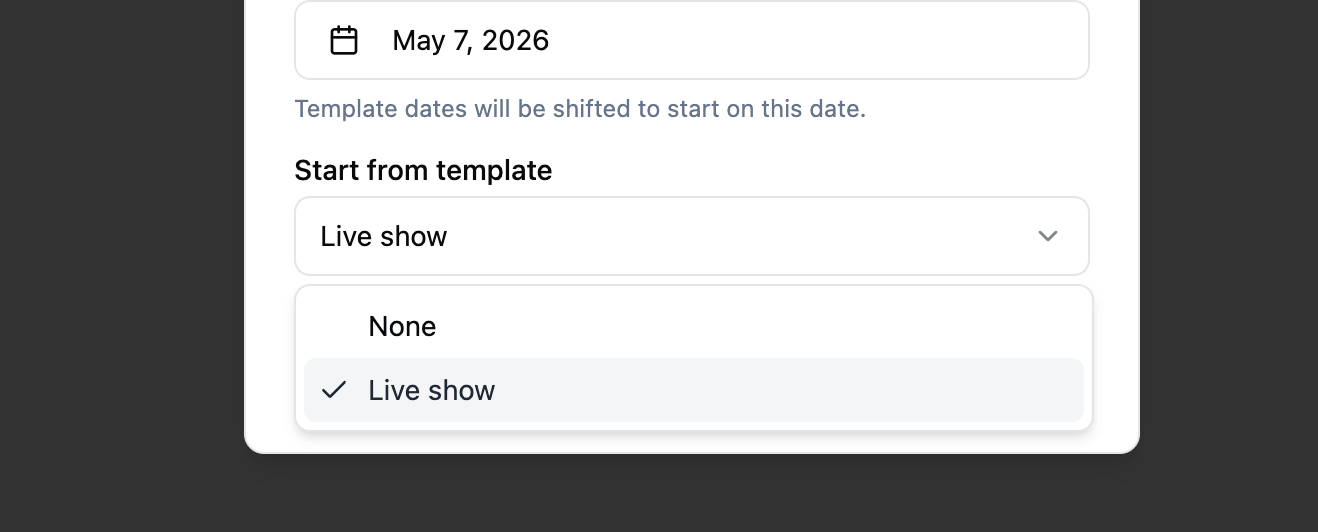 Figure: Reusable templates turn the lessons of past productions into a head start for the next one.
Wrapping up
Pre-production is not glamorous, but it’s where the real work of production happens. The time invested in planning — thorough, detailed, shared planning — pays dividends on show day. Start early, communicate clearly, and document everything.
Stay in the loop
Get product updates when new features ship. No spam, unsubscribe anytime.