July 1, 2026
How call sheets work in ProductionPlanner.io
Send a branded daily call sheet for any project date with a live PDF preview, crew call time, custom notes, and a recipient picker. A closer look at the call sheets feature.
By John Barker
The call sheet is the single page that runs the day. Crew call time at the top, schedule down the page, locations and the team roster behind it. Every production manager has assembled one in a spreadsheet at 11pm the night before a shoot, and every production manager has had to redo it when something on the schedule changed.
Call sheets in ProductionPlanner.io take the data you have already entered for a project, the schedule, the locations, the team roster, and turn it into the email and PDF your crew needs the next morning.
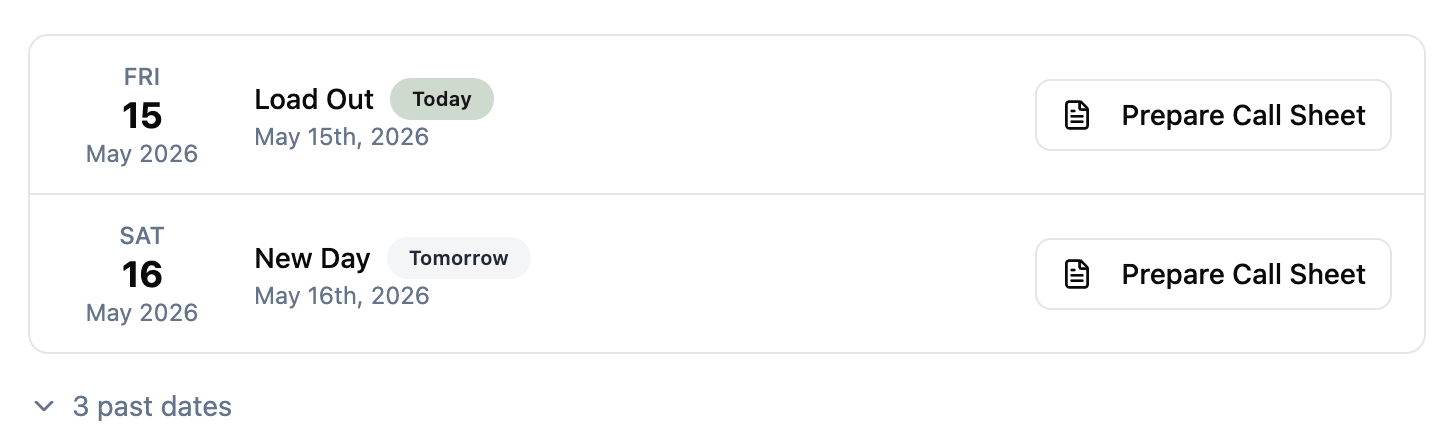
A row per date, upcoming dates first
The Call Sheets page lives in the admin section of every project. It lists every date in the project as its own row, with upcoming dates shown first and past dates tucked behind a collapsible toggle. The page stays focused on what is next, which is what you actually need when you are prepping for tomorrow.
Click Prepare Call Sheet on any row to open the Send Call Sheet dialog.
A live PDF preview as you build
The dialog is split in two. On the left you set the call sheet details. On the right a live PDF preview updates as you type, so the document you are about to send is visible the whole time you are building it.
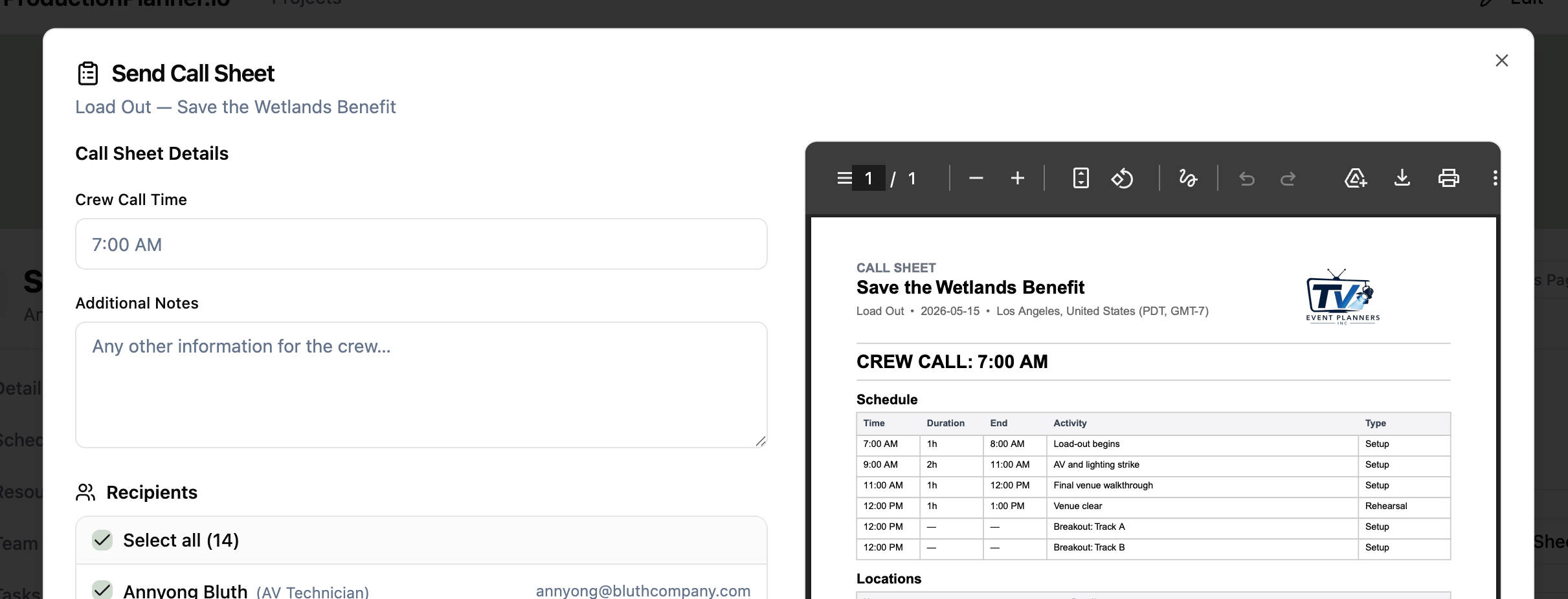
The preview includes everything that will be in the final document:
- The day’s schedule as a table with start time, duration, end, activity, and type.
- Every location on the project, with type badges and map links where available.
- The full team roster with name, role, email, and phone.
- Your crew call time and any notes you have added at the top.
No more sending a call sheet and hoping it formatted the way you expected. What you see is what your crew sees.
Two fields to fill, both optional
There are two fields that turn the data you already have into a working call sheet for the day.
Crew call time is when everyone is expected on site. It defaults to the start of the first scheduled item for the day, which is right most of the time. Override it with whatever time you actually need. It renders large and bold at the top of both the email and the PDF, so it is the first thing your crew sees.
Additional notes is a freeform field for everything that is not in the schedule. Dress code. Weather. Parking and access. Nearest hospital. Catering. Last-minute changes. It renders below the crew call time and above the schedule. Leave it blank and the section is left out entirely.
Both fields are optional. The minimum input to send a useful call sheet is no input at all: the schedule, locations, and team are already in the project.
Pick exactly who gets it
The recipient list is every team member on the project, selected by default. Deselect anyone you do not want to email, or select just one person if you are sending to a single recipient. The “Select all” toggle gives you the whole team back in one click.
This matters in two cases. A small build day where only a few people are on site does not need to go to the whole team. A vendor walkthrough that you want a specific subset of crew to see does not need to land in everyone’s inbox.
The recipients you choose see exactly the same document. The selection is just about who gets the email.
What the email and PDF look like
Each recipient gets a branded email with a clean A4 PDF attached. The PDF mirrors the email and is designed for printing or saving offline. It includes:
- A header with the project name, day label, date, and timezone.
- The crew call time and any notes up top.
- The schedule table with time, duration, end, activity, and type.
- The locations section with name, details, and type.
- The team roster with name, role, email, and phone.
- A footer with the generation date.
Long schedules paginate automatically so rows are never split across pages. Useful for full-day shoots with thirty or forty schedule items.
If the sender has set a workspace language other than English, the PDF is generated in that language with localized dates and weekday names. A Swedish-speaking producer sending to a Swedish team gets a Swedish PDF, with the right weekday names and date format, automatically.
Recipients do not need an account
The call sheet arrives in the recipient’s inbox like any other email. They do not need a ProductionPlanner.io account to read it. The PDF is attached for offline use, and the email body has the same details so they can read it without downloading anything.
This matters when you are sending to one-off vendors, drivers, or anyone else who is involved in one day of the production but is not a regular team member.
Limited to admins
The Call Sheets page is part of the admin section, so it is only visible to project members with write permission. Read-only members do not see the page in their sidebar and cannot trigger a send. This keeps the email-out trigger limited to the people running point on the production.
Every send is also recorded in the project’s activity log as “sent call sheet for [day] to N team members,” so the production has a trail of which days went out and to whom.
How it fits with the rest of the project
Call sheets are the outbound side of the project. They pull from everything else:
- The day’s schedule becomes the schedule table.
- Project locations become the locations section, with maps where available.
- The project team becomes the roster.
- Your language preference drives the PDF language.
You build the project once. The call sheet is one click and a recipient picker away.
Try it with your next production
Call sheets are part of every project on any plan. Open the Call Sheets page in your project sidebar, pick a date, set the crew call time, add any notes for the day, and pick the recipients. Send.
If you are spending the night before every shoot day rebuilding the same call sheet in a spreadsheet, create your account and try generating one from a project instead.
Read the full call sheets documentation for a detailed walkthrough.
Stay in the loop
Get product updates when new features ship. No spam, unsubscribe anytime.